

The 3rd Medical Geology Workshop – Medical Geology for Healthy Cities
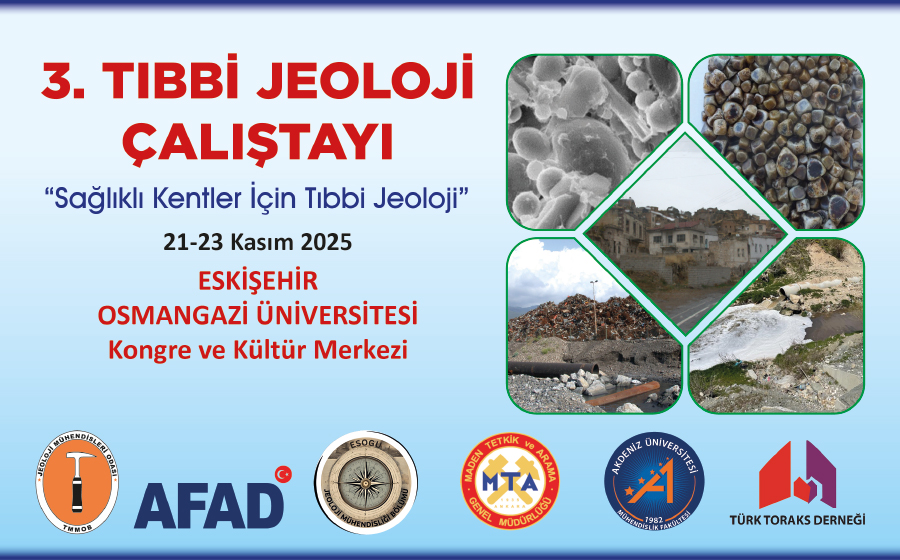
The third of the series of workshops organized in order to address public health problems caused by geogenic pollutants in our country and to discuss solution proposals for these problems, the 3rd Medical Geology Workshop with the theme “Medical Geology for Healthy Cities” was held between 21–23 November 2025 in Eskişehir, at the Eskişehir Osmangazi University Congress and Culture Center.
The Workshop was organized under the leadership of the TMMOB Chamber of Geological Engineers Central Office and Eskişehir Branch, with the joint organization of the General Directorate of MTA, AFAD Presidency, Eskişehir Osmangazi University Department of Geological Engineering, Akdeniz University Department of Geological Engineering, İLBANK Department of Planning and Coordination, the Association of Industrial Toxicology and Occupational Hygiene, and the Turkish Thoracic Society, and with the support of Süleyman Demirel University Department of Geological Engineering. In addition, a representative of the International Medical Geology Association (IMGA) supported the event as an invited speaker.
At the opening ceremony, in addition to the Mayor of Eskişehir Metropolitan Municipality Ayşe ÜNLÜCE, the Rector of Eskişehir Osmangazi University Prof. Dr. Kamil ÇOLAK, the Head of the Earthquake Research Department and the Head of the Emergency and Infrastructure Damages Department of AFAD Presidency, the Head of the Environmental Research Department of the General Directorate of MTA, the Head of the Department of Geology of Osmangazi University, officials from İller Bankası and the Turkish Thoracic Society, universities, public institutions and organizations, professional organizations and non-governmental organizations participated.
To the Workshop, in addition to the disciplines of geology, medicine, public health, hydrogeology, civil engineering, agriculture, geophysics, and computer engineering, academicians and researchers from the departments of biology, mathematics, physics, biology, and pharmacy, as well as students of the Department of Geology of Eskişehir Osmangazi University, participated. At the workshop, in which a total of 45 representatives from 4 different countries (USA, the Netherlands, Lebanon, including Türkiye) took part, a total of 55 sessions were held, consisting of 8 invited talks, 52 oral presentations, 3 poster presentations, 1 panel, and 1 Eskişehir city tour. A poster competition was held with a jury consisting of 5 different universities, and a first prize was awarded. In the impartial Workshop Scientific Committee, 34, and in the Organizing Committee, 14 distinguished academicians and sector representatives took part, and the total number of participants was 84.
Within the scope of the Workshop, the systemic effects of geogenic heavy metal toxicity (poisoning); heavy metals and asbestos minerals in the soils of the city center of Antakya (Hatay); pollution around the abandoned mercury and zinc mines in the Konya–Sızma Region; preliminary findings of medical geology studies belonging to Eskişehir; the usage characteristics of the water resources of the İnönü Plain (Eskişehir); peritoneal cancer (mesothelioma) and its treatment; environmental and geological effects in Alzheimer’s disease; the medical geology disaster history of Karain and Tuzköy (Nevşehir); the quality of the groundwater resources of central Antalya; the use of phytoplankton in lakes and rivers as indicators of water quality; pollution at the Eskişehir Solid Waste Storage Area; determination of radon concentrations in dwellings; calculation of lifetime cancer risk using the example of Bolvadin (Afyonkarahisar); the intersection points of environmental health and urban medical geology; the applications of artificial intelligence techniques in geology and medical geology studies; the effects of mining activities on air pollution, climate crisis, and health; studies on cleaning areas contaminated with heavy metals by growing plants; the evaluation of medical geological risks in urban planning in İzmir; the radiological properties of Düzköy (Trabzon) granitic rocks and Tekirova (Antalya) isolated dykes and their effects on human health; the mineralogical and geochemical comparison of asbestos occurrences in the Ankara–Çankırı and Eskişehir–Kütahya Regions and mesothelioma cases; the place of medical geology in national legislation; the use of geothermal resources for health purposes; the effects of building materials on the environment and living health and alternative solutions; the medical geological effects of sinkholes; the antimony-focused risk profile of groundwater after the earthquake in Erkenez (Kahramanmaraş); and current problems such as the use of pesticides and their relationship with health were discussed on a scientific basis. In addition, a large-scale PANEL entitled “The Importance of Medical Geology in the Formation of Healthy Cities” was organized.
Medical Geology has been defined as a JMO Medical Geology Commission that, in a multidisciplinary manner, investigates geological factors, elements in soil, water, and air that make up the natural environment, minerals and changes in the living environment related to them, anthropogenic hazards, their interactions (One Health) with human/animal/plant health, their positive or negative effects, methods of protection or utilization, and how natural resources can be used in modern medicine and diagnostic methods, and that develops solution proposals.
It has been emphasized that medical geology has vital importance in understanding the causes of diseases, protecting public health, investigating the use of natural resources for medical purposes, producing solutions to environmental health problems, conducting hazard and risk assessments, and in issues such as land-use planning and building production/inspection processes.
As a result of the views, determinations, papers, and discussions presented in the Workshop sessions, panel, and final recommendation tables, the steps and measures that need to be taken in the field of medical geology and the regulations that must be made are presented to the public as follows:
- It has been adopted that medical geology assumes a critical bridging role between different disciplines such as medicine, geology, public health, hydrogeology, biology, chemistry, dentistry, pharmacy, epidemiology, physics, urban planning, environmental engineering, civil engineering, mining engineering, geomatics engineering, mathematics, statistics, agriculture–soil, food, and veterinary sciences. In this context: The strengthening of the TMMOB Chamber of Geological Engineers Medical Geology Working Group to include different professional disciplines, The regular organization of Medical Geology Workshops at specific intervals, The strengthening of cooperation with the International Medical Geology Association (IMGA) and the transfer of international knowledge to our country has been adopted. In addition, it has been adopted that these groups should develop projects aimed at solving defined health–environment problems related to geological factors and protecting ecosystem health with a “One Health” approach.
- Within the scope of establishing preventive and protective health policies to improve the quality of life in urban and rural settlements, it has been considered necessary that a strategic plan on Medical Geology be prepared with the Ministry of Health in the lead, bringing together the Ministry of Environment, Urbanization and Climate Change, Geological Engineering Departments and Medical Faculty Public Health Departments of universities, AFAD Presidency, MTA General Directorate, DSİ General Directorate, General Directorate of Water Management, TÜBİTAK, Metropolitan (and other) Municipalities, Provincial Health Directorates and Professional Chambers.
- In our country, in order to carry out the necessary research within the scope of the effects of Geological Environments on Human Health (Medical Geology) and preventive health services, to ensure their continuity, and to prevent problems of medical geology origin: As in the geological research institutions of developed countries such as the USA, EU countries, the United Kingdom, and Japan (USGS, BGS, etc.), it has been adopted that a “Medical Geology Research Coordination Unit” be established within the Environmental Research Department of the General Directorate of MTA for the determination of minerals or elements that have significant effects on human (animal and plant) health and for the preparation of hazard maps. It has been adopted that, within AFAD Presidency, for the purpose of combating disasters of medical geology origin, a “Medical Geology-Originated Disaster Risk Reduction Coordination Unit or Section” be established within the Earthquake and Risk Reduction General Directorate. This unit should carry out studies, in cooperation with other relevant institutions, to include the residential areas where deaths due to medical geology problems are experienced within the scope of the Disaster Law, and to improve the area with engineering services or to relocate the settlement. It has been stated that this unit should also conduct national legislation reviews and carry out regulatory legislative work to ensure that medical geology risk maps are considered in planning, building production, and supervision processes. In the context of compensating the damages of citizens affected by Medical Geology and nature-originated disaster risks, it has been adopted that the types of disasters defined in Law No. 7269 on Measures to be Taken in Disasters Affecting Public Life be expanded within the scope of Medical Geology to include current hazards such as natural asbestos exposures and sinkholes/collapses, and that legislative regulations be made to develop property registration and insurance processes for the mentioned hazards.
- The effects on human health of rocks, soils, and groundwater/surface waters in natural environments, especially possible mining-origin (anthropogenic) toxic heavy metals (e.g., As, Hg, Pb, Cd, Ni, etc.), asbestos-form minerals (asbestos group minerals and erionite, etc.), radioactivity and radiological properties, and radon gas distribution, arising from natural (geogenic) and anthropogenic sources, have been evaluated in detail. It has been emphasized that, as a part of urban planning in developed countries since the 1960s, it is also necessary to prepare Medical Geology Hazard and Risk Maps in Türkiye. The importance of the sustainable continuation of mining activities and natural resource efficiency with scientific data–based planning, strict monitoring, supervision, and strong institutional cooperation, which form the basis of a proactive and integrated approach that aims to optimize environmental and public health simultaneously and that is accepted as part of the urban ecosystem, has been emphasized. For areas abandoned after mining activities and in areas where possible anthropogenic pollution exists, it has been proposed that maps showing the health–geology relationship and possible risks be produced using artificial intelligence–assisted machine learning, numerical simulation models, remote sensing, and GIS-based spatial analyses. The importance of the pilot study and geochemistry atlas initiated by the General Directorate of MTA in Eskişehir, as an example for new studies to be carried out, has been stated. In this context; it has been expressed that AFAD Presidency, MTA General Directorate, the General Directorate of Public Health of the Ministry of Health, relevant university departments, and professional organizations should come together and, considering minerals and elements that have negative effects on public health, the national “Türkiye Medical Geology Hazard Maps” and “Türkiye Medical Geology Risk Maps” and the “Geochemistry Atlas” in compliance with international norms should be prepared as a priority, published, and that these maps should be continuously updated in the light of scientific and technical studies. It is expected that all stakeholders (such as MTA, AFAD, DSİ, universities, and local governments) will have access to all of these maps via a cloud-based platform.
- The critical contribution of the integration of geological data into urban planning and engineering services in the creation of healthy living conditions has been discussed. It has been emphasized that Medical Geology Hazard and Risk Maps to be prepared with soil, water, and rock geochemistry data should be integrated by the Ministry of Environment, Urbanization and Climate Change and local governments into urban investment and land-use decisions, spatial and local environmental plans and zoning plans of all scales, and building processes, and that this is important for the creation of “Healthy Cities” with high quality of life and living environments that are resilient and safe against hazards and risks arising from disasters and climate change.
- Medical Geology Hazard and Risk Maps to be prepared by the relevant institutions must be made accessible to all public institutions and universities via the Türkiye National Geographic Information Systems (TUCBS). For this purpose, the necessary legislative amendments must be made by the Ministry of Environment and Urbanization so that the prepared thematic maps can be integrated into zoning, planning, and building processes. In addition, for the effective use of geology, geochemistry, and hydrogeochemistry data in the fields of health and environment, data-sharing protocols should be established among relevant institutions such as universities, MTA, DSİ, MAPEG, AFAD, local governments, municipal water and sewerage administrations, professional organizations, and NGOs, the necessary importance should be given to this issue, and the protocols should be regularly updated.
- Institutions such as TÜBİTAK, MTA, AFAD, and universities should create invited and guided multidisciplinary projects in order for Medical Geology studies to be carried out in our country within the scope of preventive health services, and for hazard and risk maps covering the entire country, cities, and districts to be used as a decisive data source in positioning residential areas, agricultural lands, and drinking water resources in a way that minimizes exposure risk, and for comprehensive project calls to be issued. It has been emphasized that it is important that the results of the projects be made available to the public and decision-makers on the websites of institutions within the ARAS (Disaster Risk Reduction) infrastructure under the coordination of AFAD Presidency.
- In order to reduce the negative effects on the environment and human health of nature-originated disasters such as earthquakes, landslides, floods, avalanches, sinkholes/collapses that directly affect human life, sensitivity, hazard, and risk maps should be created across the country with the cooperation of AFAD, MTA, and universities. These maps should be taken as a basis not only in determining geogenic risks of geological origin but also in determining anthropogenic pollution.
- It has been stated that, in order for drinking water and treatment plants to be operated effectively, efficiently, and sustainably, it is of vital importance that these plants be audited by academic boards and enforcement state departments and that, for the examination of natural environments, consultancy services be obtained from at least 3 different disciplines, primarily geological engineers, and that all of these processes must be accessible in report form. Especially in discharge areas and arsenic-bearing regions (ophiolitic areas and volcanic regions), water treatment methods must be clearly announced, and all processes, from the chemicals used to the disposal of treated arsenic and/or heavy metals and/or waste materials in accordance with the regulations, must be meticulously inspected, and all reports, including consultancy reports, must be published on institutional websites.
- Although it is stated in Law No. 167 on Groundwater, cooperation must be established with institutions such as DSİ and SYGM to prevent the use of groundwater and the drilling of unlicensed wells, and existing wells must be inspected and those that are unsuitable must be closed according to a specific plan, and the pollution of currently usable groundwater must be prevented.
- Municipal Water and Sewerage Administrations must publish daily physical–chemical–bacteriological analysis results of drinking water transparently on their websites, as in meteorological air pollution information, and must provide data for all scientific studies.
- As at Hacettepe University, “Mesothelioma and Medical Geology Application and Research Centers/Institutes” should be established in some universities in order to rapidly survey the geography of the country, to determine places that are considered problematic in terms of medical geology, and to develop rehabilitation programs. For this purpose, Medical Geology Research Centers should be established in universities where geological engineering departments exist. These centers will enable different professional disciplines to work together on joint studies and will help increase the number of qualified experts in this field in our country.
- In recent years in our country, it has been stated that the waste management system of millions of tons of demolition debris that emerged/emerges during the implementation of urban transformation projects under Law No. 6306 and after the 6 February Kahramanmaraş earthquakes should be restructured, and that “dust and asbestos safety in demolitions” should become one of the fundamental criteria. In addition, the Ministry of Environment, Urbanization and Climate Change should urgently initiate work to determine and organize the areas where demolition debris will be stored so that they do not pose a threat to public health, geochemical analyses should be conducted to determine the inventory of carcinogenic chemicals and asbestos in buildings, and the start of main demolition operations must be prevented until the disposal of identified hazardous substances is ensured.
- In recent years in our country, it has been stated that the possible increase in cancer cases after exposure to toxic heavy metals such as asbestos in approximately 379 settlements in 61 provinces, and the fact that the consequences of “carcinogenic chemical pollutants and asbestos exposure” become evident 30–40 years later, cause the exposures arising from both the natural and built environment to be ignored today; it has been emphasized that prevention projects against existing high risks must be implemented urgently by relevant public institutions. In addition, it has been stated that, in the relevant articles of Law No. 6331 on Occupational Health and Safety, legislative regulations must be made not only for risks seen as “imminent danger” but also for health and safety measures that will protect employees from factors arising from the working environment to which they will be exposed “over long periods of time.”
- It has been stated that the subject of medical geology, which is defined by the International Union of Geological Sciences (IUGS) as a sub-specialty and multidisciplinary field of geological science and engineering, should be included in the curricula and educational programs of the geology departments and medical faculties of our universities.
- In order to increase social awareness in the field of medical geology, education and information activities must be expanded under the leadership of the TMMOB Chamber of Geological Engineers, in cooperation with universities, local governments, national non-governmental organizations, the International Medical Geology Association (IMGA), and the media.
- In order for medical geology issues to be implemented more effectively in practice, national and international legislation should be examined, and the necessary studies and research should be carried out to develop legislation at the level of laws, regulations, directives, and standards. It has been emphasized that the number and locations of samples to be taken, analysis methods, and methods to be applied must be harmonized with international studies, and that creating a national standard on this issue is important for ensuring coherence.
As a result, the 3rd Medical Geology Workshop, organized under the main theme of “Medical Geology for Healthy Cities,” has been successfully completed with the contributions of all participants and has drawn an important roadmap for future steps to be taken in the field of medical geology.
The protection of public health and the creation of healthy cities is one of the important issues of our country. As the components of the Workshop, we respectfully announce to the public that we are ready to contribute to the development and improvement of studies in the field of medical geology and that we will continue to provide all kinds of support in this direction.
On behalf of the Organizing Committee of the 3rd Medical Geology Workshop
Prof. Dr. M. Gürhan YALÇIN
Chairman of the JMO Medical Geology Commission
IMGA Türkiye Chamber President
More Details can be found at https://www.jmo.org.tr/etkinlikler/calistay/index.php?etkinlikkod=163.